
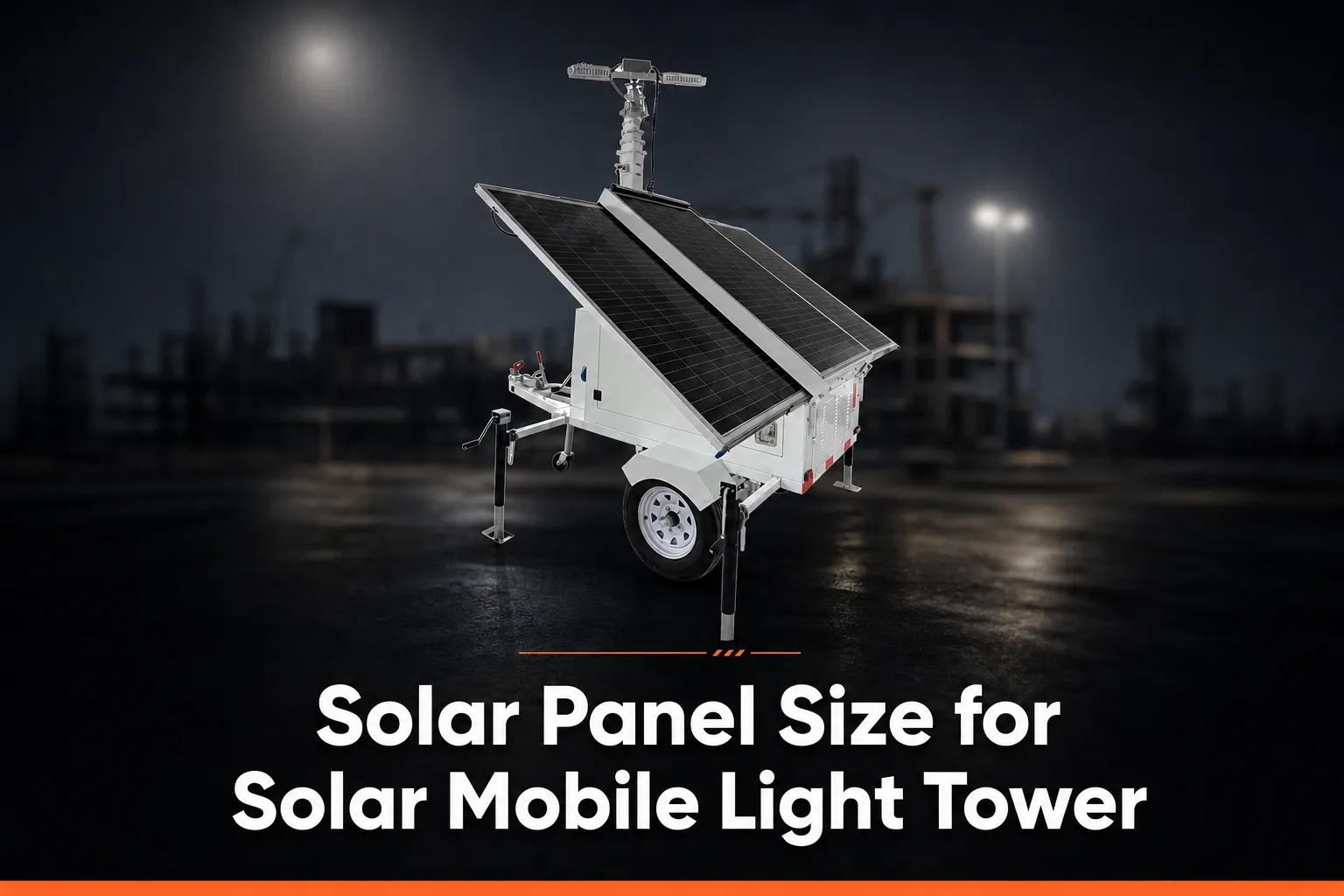
Solar Panel Size for Solar Mobile Light Tower
One of the most crucial choices for contractors, rental services, event coordinators, mining sites, and emergency responders to make when selecting a solar mobile light tower is selecting the proper size for their solar panel system. A small or insufficiently sized solar array may not supply enough energy to operate the tower all night long or allow the tower to recharge fully during periods of cloudy weather. A poorly oversized solar panel system can add unmanageable weight to the entire system, make it more expensive due to excess material cost, and reduce efficiency based on the potential ROI of the system.
A well-designed solar panel light tower should integrate four critical principles: the amount of lighting power required, the number of nighttime working hours, local climatic conditions with regard to solar insolation, and available battery storage capacity. This article explains how to size your solar panel, what specifications you should compare when selecting a solar mobile light tower, and how to determine whether a mobile solar lighting tower will successfully meet the operational demands of a given jobsite.
The Importance of the Solar Panel Size for Mobile Light Towers
The energy source for a mobile light tower is the solar panels. When sunlight hits the solar panels, they create usable energy by producing electricity, and that electrical energy charges the battery bank during the day. At night, the battery can be used to power the LED floodlights, control circuitry, and any additional equipment. The size of the solar panel will considerably affect how quickly the batteries recharge and how well the mobile light tower functions over multiple nights of use.
Aside from the fact that solar panel size is a technical specification, it directly affects equipment runtime, dependability, total operating costs, required maintenance frequency, transportation cost, and the overall value of the equipment. Using correctly sized solar panels can help reduce fuel use, lower noise from diesel generators, eliminate engine maintenance, and create a source of off-grid lighting for remote locations.
When it comes to solar panel sizing, there really is not one size that fits all. Each location has different hours of sunlight and climate conditions, which means you need to calculate how many panels you will need based on the specific needs of the area where you will use your mobile light tower. For example, a road-building jobsite in Arizona, a mining camp in Western Australia, and a winter event site in Northern Europe all have different calculations because they have different sunlight hours, weather patterns, and lighting requirements.
Typical Solar Panel Size for Solar Mobile Light Towers
Typically, for solar mobile light towers, the size of the solar panel arrays used can vary anywhere from 800 to 2,400 watts depending on the size of the light tower and the output of the LEDs. Smaller compact mobile light towers may use solar panels that vary from 600 to 1,000 watts, while larger heavy-duty industrial-grade mobile light towers intended for extended runtimes may use 1,500 to 3,000 watts or more.
For general jobsite lighting, most users use around 1,000 to 1,800 watt solar panel configurations in conjunction with highly efficient LED fixtures and either lithium or gel battery banks. This configuration is often sufficient for construction sites, temporary parking lots, perimeter security, exterior events, road building, and municipal projects.
With that said, when evaluating solar panel wattage, it is important not to evaluate a solar array by itself. For instance, a 1,200 watt solar array may work very well in a high-sun area but may not work well in a cloudy or higher-latitude area if you want to operate the light for 10 to 12 hours every night. Professional specifications for mobile light towers powered by solar energy typically include solar panel wattage, battery size and capacity, LED power use, expected hours of operation, and expected charging time.
How to Calculate Solar Panel Size for a Solar Mobile Light Tower
The process of determining how many solar panels you need for a mobile light tower is rather simple. The energy produced by the solar panels during the day must be sufficient to replace the energy used by the mobile light tower for lighting at night. You must also account for system losses and provide a cushion in case of inclement weather.
The following formula may be used as a guideline:
Required solar panel wattage = daily energy consumption ÷ peak sun hours ÷ system efficiency
For example, if a mobile solar tower has four LED lights that use 100 watts each, the total number of watts required for the tower during operation would be 400 watts. If the tower operates for 10 hours per night, the daily energy consumption is:
400W × 10 hours = 4,000Wh, or 4kWh per night
Assuming the tower will operate in an area that receives 5 hours of peak sunshine per day and that the system has an efficiency of 75% after accounting for wiring, controller loss, battery charging loss, temperature, and dust, you could use this formula to determine how many watts of solar panels you would need:
4,000Wh ÷ 5 ÷ 0.75 = approximately 1,067W
In this particular example, a 1,100 to 1,300 watt solar panel array would be sufficient as a starting point. If the customer requires a higher level of cloudy-day or winter-day recovery, additional solar panels may need to be used, increasing the array to 1,500 watts or greater.
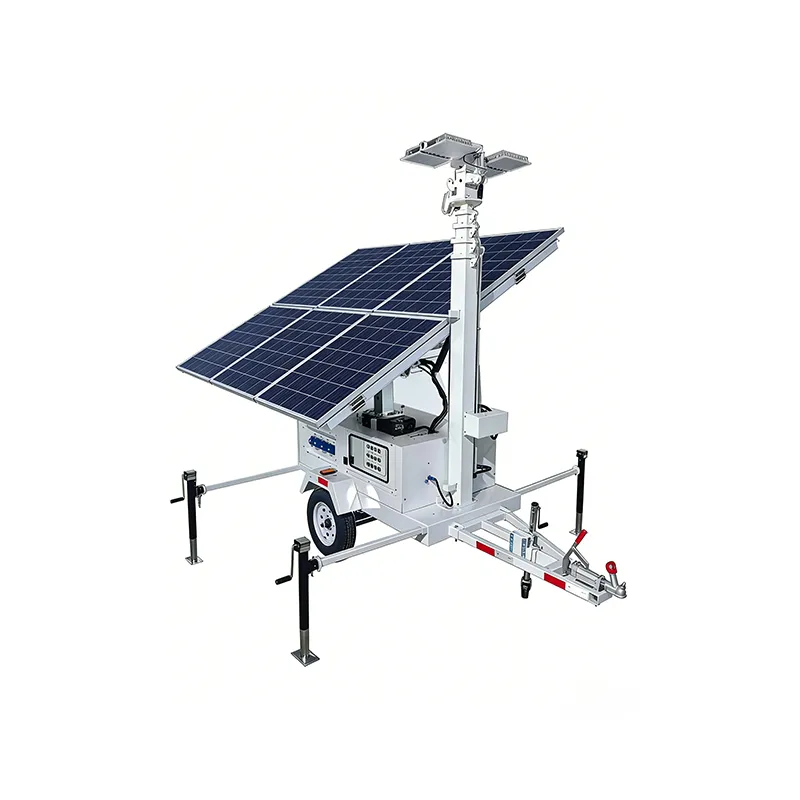
Factors Determining Size of Solar Panels
1. LED Light Power and Efficiency
LED lights are a significant factor in determining how many solar panels will be needed for solar-powered light towers. High-efficiency LED floodlights are now available as an alternative to traditional metal halide lamps, producing high-output illumination while consuming less energy. A decent-sized tower designed with 400 watts of LED power can replace many large diesel light towers, since the directivity of the light produced by LEDs results in less wasted light and less heat energy.
When assessing the specs of a solar light tower, buyers need to consider not just the lamp wattage, but also the lumen output, beam angle, lighting area, color temperature, and optical design of the lamps. A lower-wattage LED system may provide equal or superior usable light compared with a higher-wattage system with poor dispersion characteristics due to superior optics.
2. Operating Time Per Night Required
A tower operating only 6 hours per night will require much less energy than one that operates from dusk to dawn. Most security and construction lighting applications typically require 10 to 12 hours of light per night, and longer lighting hours are often required in winter due to longer nights. Event lighting may need only a few hours of use per event; however, some applications such as remote surveillance or critical infrastructure may require all-night operation.
Buyers should clearly define the anticipated operating schedule before selecting the appropriate solar panel size for the light tower. If motion sensors, dimming options, or programmable timers are included in the light tower design, they may reduce energy consumption and significantly affect the solar panel size needed or extend the battery backup time.
3. Peak Sun Hours At Project Site/Location
Peak sun hours are not the same as daytime hours. They represent the equivalent number of hours per day that the average intensity of sunlight is equal to 1,000 watts per square meter. A sunny desert may have between 5.5 and 7 peak sun hours every day, whereas cloudy coastal or northern regions may have as low as 2.5 to 4 peak sun hours during seasonal periods.
This is the primary reason for having a solar panel light tower that is sized according to the location where it will be deployed. If suppliers only provide a standard runtime estimate and do not ask about location, season, and how many hours of light you want, it is possible the system will not be properly matched to your needs.
4. Battery Size & Autonomy Days
Batteries and solar panels must be designed as one complete system. The solar panels will recharge the batteries; however, the battery bank will determine how many hours of operation are available at night or when the weather is cloudy. Autonomy is the number of nights the solar light tower can continue operating without adequate solar recharge.
Typically, in most commercial applications, between one and three days of autonomy may be required. Critical locations may require even more. If the mobile solar light tower has an oversized battery bank but the solar panels are undersized, it may operate the first night but will not recharge adequately over several cycles. On the other hand, if the solar panels are large but the battery storage is small, some solar electricity will be wasted because there will not be enough space to store it after the battery reaches capacity.
5. Seasonal Weather & Temperature
Weather conditions and temperature can significantly affect the performance of solar electric equipment. Solar panels will usually produce less electric energy during cloudy conditions than during sunny conditions, and in dusty areas, the panels may need to be washed often. Batteries behave differently depending on the type of chemistry they are made of and the temperature. Compared to many traditional batteries, lithium-ion batteries have a higher usable capacity and a longer cycle life, but they still require proper battery management and thermal protection to operate safely.
When sizing a battery-operated light tower for year-round operation, it is important to do so based on the worst practical season in which the light tower will be used, rather than basing the size only on best-case summer conditions. This is especially important for lighting projects associated with roadwork, security, and mining. Failure of these lighting systems can interrupt work or create safety issues.
Recommended Solar Panel Sizes for Specific Applications
Even though every project should be evaluated on an individual basis, the following general guidelines can give prospective buyers an idea of typical sizing ranges for mobile solar light towers.
- Small event areas, temporary walkways, and very light-duty security applications: 600 to 1,000 watts of solar panels.
- Construction sites, roadwork, parking lots, and general commercial lighting applications: 1,000 to 1,800 watts of solar panels.
- Mining, remote industrial environments, long-duration security, and high-output lighting applications: over 1,800 watts of solar panels.
If the estimated panel wattage in these categories is used in conjunction with LED luminaires that are properly matched to battery capacity and installed in locations with reasonable amounts of direct sunlight, there should be sufficient energy generated each day to operate the light fixtures for the duration of their respective applications. In areas that experience low sunlight, or for systems operated during winter months, it may be wise to either increase the solar capacity or purchase a hybrid solar light tower with added charging capability.
What to Look For in Solar Light Tower Specifications
When evaluating potential suppliers, prospective buyers should not just evaluate the headline wattage of the panels being provided. An acceptable specification sheet from a manufacturer should include detailed performance metrics that clearly indicate how the mobile solar light tower functions when used as one complete energy system. Important details include solar panel wattage, LED lamp wattage, total lumen output, battery type, battery capacity in kWh, charge time, runtime per night, mast height, wind resistance, trailer style, controller type, and operating temperature range.
It is also important to check whether the solar panels are fixed, foldable, tiltable, or automatically tilting. Foldable or tiltable panels can help collect more sunlight and be easier to transport. The mechanical structure of the mobile solar light tower is critical because the tower must be easy to deploy, stable in the elements, and durable enough to be moved from jobsite to jobsite.
Be wary of vague statements like “will run all night” or “requires no maintenance” without supporting documentation when purchasing your system. An experienced supplier will be able to explain how they calculated the runtime of the light, including how much load exists on the LED lights, how many kWh the battery has, how many hours of sunlight are available in your area, and the overall weather patterns in your area.
Solar Panel Size vs. Battery Size: Which Is Most Important?
Both solar panel size and battery size are equally important; however, each solves a different problem. The size of the solar panel determines how much energy the system can collect during the day. The size of the battery determines how much energy can be stored and used at night. If either the solar panel or the battery is undersized, the performance of the tower will be compromised.
For example, if a tower has a large battery but a small solar panel, it may not recover from multiple days of cloudy weather. Conversely, if the tower has a large solar panel but a small battery, it may not provide enough energy to last through a long night. When designing a solar power system, you want to ensure the output of the panel, the capacity of the battery, and the load of the LED match the actual usage of your site.
In practical terms, buyers should request a complete energy balance from their suppliers rather than just looking at panel wattage when making comparisons. The best solar panel light tower is the one that provides adequate lighting with the lowest overall operating cost, rather than simply being the one with the largest panel array.
Is a Solar-Only or Hybrid Mobile Light Tower Right for You?
A solar-only mobile light tower is the best option for sites that receive a sufficient amount of sunlight, have moderate lighting needs, and prefer to operate quietly and without fuel. Solar-only towers are frequently used at construction sites, events, security locations, parking lots, remote roads, and environmentally sensitive areas.
Hybrid mobile light towers use both solar power and an alternate source of charging, such as a small diesel generator, grid power, or an external charger. A hybrid tower may be a good solution for areas that experience long periods of rain, winter operation, or critical 24/7 lighting that cannot be interrupted.
While hybrid towers typically have a higher upfront cost, they offer added flexibility to the user. For rental fleets, hybrid towers are appealing because they provide the ability to serve a larger customer base and work at more locations. In locations with stringent carbon reduction goals, solar-first operation can significantly reduce fuel use while still providing a backup source of energy.
How Oversizing or Undersizing Affects Performance
The most common issue with undersizing solar panels is that the battery does not get fully charged, resulting in less runtime before being depleted. Batteries may be discharged more deeply each day, decreasing battery life and providing unreliable lighting. Over time, increased maintenance costs can lead to decreased customer satisfaction, and in the case of rental equipment, this can also reduce overall satisfaction.
Oversizing panels may introduce problems such as increased weight, wind load, transport dimensions, and equipment costs if engineered improperly. Moderate oversizing, however, may be beneficial under average conditions because it provides an added safety margin for cloudy days, dust, aging panels, and seasonal climate variations.
When designing a solar array, it is best practice to first size the array based on average daily consumption, then add a reasonable amount of extra capacity based on average climate and application risks. More safety capacity should be added for mission-critical lighting than for other applications.
Frequently Asked Questions
What size should the solar panel be on a mobile solar light tower?
The optimal size of the solar panel is based on several factors, including the amount of LED power, the total runtime desired, the amount of battery power required, and the number of peak sun hours in your area. For most commercial applications, a common range is between 1,000W and 1,800W. In instances where heavy-duty or long runtimes are necessary, the size of solar panel needed could be greater, such as between 2,000W and 3,000W, depending on the application.
How many solar panels does a mobile solar light tower require?
The number of solar panels is tied to the wattage of each panel as well as the total required array size. For example, if you are using a 1,200W mobile solar light tower, you may be able to use three 400W panels or four 300W panels. From a physical standpoint, the configuration of the mobile solar light tower must take into account the overall trailer size, folding design, wind resistance, and safety during transport.
Can a mobile solar light tower operate through the night?
Yes, provided that the load of the LEDs, the capacity of the batteries, and the size of the solar panels are all properly balanced. Most mobile solar light towers are capable of running for between 8 and 12 hours based on the setup of these items. Some mobile solar light towers can operate longer due to dimming controls, motion detectors, larger batteries, and/or hybrid backup charging capabilities.
What happens if the output of the mobile solar light tower’s solar panels is too small?
If the solar panels are too small, the mobile solar light tower’s batteries may not recharge adequately during the day. As a result, there is the potential for shorter runtimes, reduced illumination levels, deeper battery discharges, and shorter battery life. This same issue will be compounded during periods of extended cloudy weather.
Are larger solar panel arrays always better?
No, not always. Larger solar panels may provide better charging and cloudy-day charging capacity; however, larger solar panels typically increase the overall cost, weight, wind load, and complexity of transporting the mobile solar light tower. The appropriate choice is to determine a balance between solar input, battery storage, LED power demand, and site/environment performance.
How do I compare various mobile solar light tower specifications?
Be sure to evaluate the entire system of the mobile solar light tower and not simply one figure. When comparing mobile solar light towers, consider solar panel wattage, LED power, lumen output, battery capacity, battery runtime, battery charging time, mast height, controller quality, trailer structure, wind rating, and warranty. A supplier with integrity should provide an explanation of what was considered to develop the performance specifications for their mobile solar light tower.
In selecting a mobile solar light tower, be sure to assess the actual operating performance and not just the maximum rated wattage. An engineered mobile solar light tower will generate enough solar energy to properly charge the batteries on a regular basis, provide enough battery storage to power LED operation during nighttime hours, and efficiently illuminate the surface area to be lit without wasting energy in the form of heat, glare, or poor distribution.
If your project requires a reliable off-grid lighting solution, be sure to request a sizing analysis based on your project location, the desired runtime, and the area you will be illuminating. This will help ensure that the size of the mobile solar light tower’s solar panel is representative of the actual conditions found in your location rather than a generic specification. In conclusion, the optimum size of a mobile solar light tower’s solar panel is the size that creates a balance between solar input, battery storage, LED demand, and site/environment factors so that the tower provides a reliable, long-lasting, low-maintenance source of illumination on a consistent basis.